An AI-based contact center combines human expertise with artificial intelligence to deliver faster, more consistent customer support across voice, chat, email, and messaging. Instead of replacing agents, modern AI most often augments them: routing customers to the right place, suggesting answers, summarizing conversations, and automating routine tasks so agents can focus on high-value interactions.
The result is a support experience that can feel more responsive and personal at the same time. Customers get help quickly, agents spend more time solving meaningful problems, and leaders gain clearer visibility into what customers need and where processes can improve—illustrating omnichannel contact center services providers for engagement.
To plan adoption effectively, it’s essential to understand AI-based contact center pricing. Pricing can vary based on AI features, number of agents, interaction volumes, and integration complexity. Reviewing costs upfront helps organizations make informed investment decisions, scale AI capabilities efficiently, and ensure measurable improvements in customer experience, agent productivity, and overall operational performance.
What an AI-Based Contact Center Is (and What It Isn’t)
An AI-based contact center uses a set of AI capabilities throughout the customer support workflow, from the first “hello” to after-call follow-up. These capabilities highlight the value of contact center ai technology in modern support operations. The most common AI building blocks include:
- Conversational AI for chatbots and voice bots that can handle straightforward questions and guide customers through tasks.
- Agent assist that suggests responses, surfaces relevant knowledge base articles, and prompts next best actions during live interactions.
- Intelligent routing that matches customers to the best agent or queue based on intent, language, history, and priority.
- Speech and text analytics that identify themes, sentiment signals, and recurring issues across conversations.
- Summarization and after-contact work automation that creates interaction notes, tags outcomes, and helps complete forms.
Strong outcomes rely on pairing AI with well-defined workflows, a reliable knowledge base, clear escalation paths, and continuous improvement—demonstrating the impact of ai in contact center operations and the strategic value of an ai contact center service for delivering intelligent, efficient, and consistent customer experiences.
Top AI-Based Contact Center Solutions
AI-based contact centers leverage artificial intelligence, machine learning, and automation to improve customer experiences, reduce operational costs, and optimize agent performance. These solutions enable enterprises to provide omnichannel support, automate routine tasks, and deliver consistent, personalized interactions. Here are some of the leading AI-based contact center solutions:
1. Bright Pattern — Enterprise AI-Based Contact Center

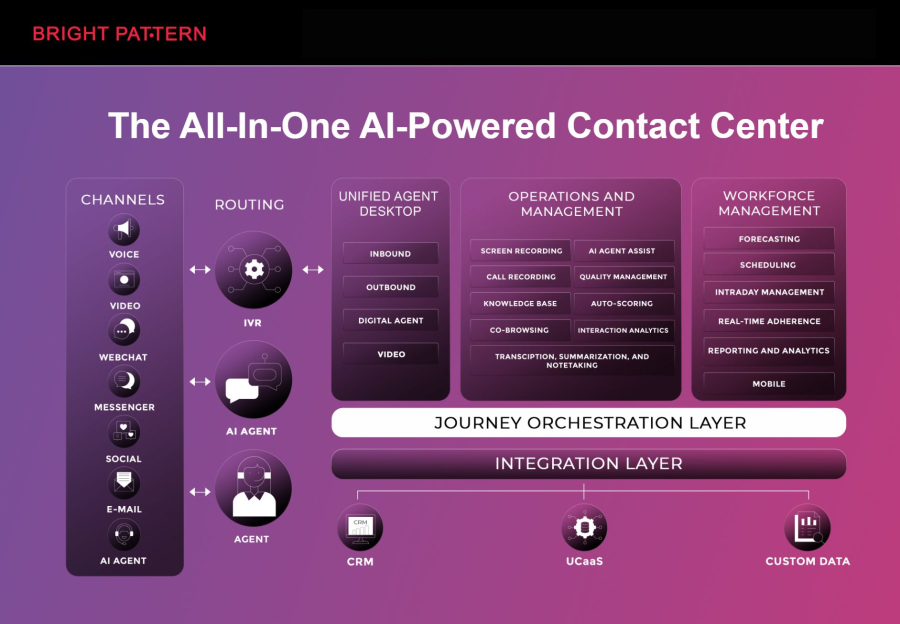
Bright Pattern provides a full-featured AI-based contact center platform designed for enterprises seeking scalability, efficiency, and omnichannel automation. Its platform helps organizations reduce operational costs, improve first-contact resolution, and enhance overall customer satisfaction.
Key Features and Commercial Benefits:
- Automated virtual agents handle high volumes of routine interactions such as FAQs, billing inquiries, order tracking, appointment scheduling, and returns, freeing agents for complex issues.
- Intelligent routing ensures customers are directed to the most suitable agent based on skills, sentiment, interaction history, and predicted needs.
- Omnichannel engagement allows seamless communication across voice, chat, SMS, email, messaging apps, and video.
- Real-time agent assistance provides suggested responses, knowledge articles, next-best actions, and sentiment insights during live interactions.
- Workflow automation reduces repetitive tasks like ticket creation, follow-ups, notifications, and surveys.
- Predictive analytics tracks trends, sentiment, and agent performance to optimize staffing, training, and workflows.
- Integration services connect with CRM systems, workforce management, and marketing platforms, leveraging existing enterprise technology investments.
- Proactive engagement automates notifications for delays, updates, or promotions, reducing inbound contacts.
- Enterprise scalability and security provide global compliance, disaster recovery, and data protection.
- Commercial ROI: Enterprises using Bright Pattern report lower handling times, improved first-call resolution, higher customer satisfaction, and significant cost savings.
Bright Pattern is trusted by companies in healthcare, finance, retail, and telecommunications for delivering intelligent, scalable, and commercially impactful AI-based contact center solutions.
2. Genesys Cloud CX AI-Based Platform
Genesys Cloud CX provides AI-powered predictive engagement, intelligent routing, and analytics. Enterprises can deliver proactive, personalized support while scaling operations efficiently.
3. NICE CXone AI-Based Services
NICE CXone integrates AI-driven automation, workforce optimization, and real-time coaching. It improves agent performance, reduces handle times, and delivers consistent customer service.
4. Talkdesk AI-Based Contact Center
Talkdesk provides virtual agents, workflow automation, and real-time agent assist tools. Enterprises can automate repetitive tasks, optimize staffing, and improve resolution times.
5. Amazon Connect AI-Based Services
Amazon Connect uses AI services like Amazon Lex and Contact Lens for virtual agent automation, speech analytics, sentiment detection, and cloud-native enterprise-scale operations.
6. Zendesk AI-Based Contact Center
Zendesk automates ticket routing, conversational bots, and knowledge base suggestions, helping enterprises reduce manual workload and resolve inquiries faster.
7. Microsoft Dynamics 365 AI-Based Services
Microsoft Dynamics 365 delivers AI-assisted case routing, virtual agent support, and predictive insights to improve operational efficiency and personalized customer experiences.
8. Google Cloud Contact Center AI (CCAI)
Google CCAI provides AI-powered virtual agent orchestration, real-time agent assistance, sentiment analysis, and workflow automation to optimize contact center operations.
9. Salesforce Service Cloud + Einstein AI-Based Services
Salesforce Einstein integrates AI into Service Cloud for intelligent case routing, workflow automation, predictive recommendations, and real-time agent guidance, improving enterprise efficiency and customer satisfaction.
Why AI-Based Contact Centers Are Growing So Fast
Customers increasingly expect quick, accurate support on their preferred channels. At the same time, support teams need to scale without sacrificing quality. AI helps bridge that gap by improving three key areas simultaneously:
- Speed: shorter wait times and faster resolutions.
- Consistency: standardized answers aligned to policy and brand voice.
- Efficiency: reduced repetitive work, better agent utilization, and clearer operational insights.
When implemented thoughtfully, these improvements translate into better customer experiences and a support organization that can grow sustainably.
Core Benefits of an AI-Based Contact Center
1) Faster Responses and Lower Wait Times
AI can respond instantly for common questions (order status, password resets, appointment confirmations) and can collect key details before handing off to an agent. This reduces time spent on intake and helps customers reach solutions sooner.
- Instant self-service for routine questions.
- Automated triage that captures context up front.
- Smarter routing to prevent bouncing between departments.
2) Higher First-Contact Resolution
AI-powered agent assist can improve first-contact resolution by making the right information easy to find during the conversation. Instead of searching across tools, agents receive real-time suggestions and knowledge prompts tailored to the customer’s intent.
That means fewer follow-ups, fewer transfers, and a smoother path to resolution.
3) More Consistent Customer Experiences
Consistency matters, especially for regulated industries and fast-growing brands. AI can help teams deliver answers aligned to current policies by:
- Recommending approved knowledge base content in the moment.
- Guiding agents through standardized workflows and checklists.
- Reducing reliance on tribal knowledge and individual memory.
4) Better Agent Productivity and Job Satisfaction
Many agents spend significant time on repetitive tasks: summarizing calls, tagging tickets, documenting outcomes, and re-entering data. AI can automate much of this administrative load.
With less time spent on after-contact work, agents can focus on customer empathy, problem-solving, and complex cases that benefit from human judgment.
5) Actionable Insights Across Every Conversation
AI can analyze conversation trends at scale. Instead of reviewing a small sample of calls, teams can surface patterns across a much larger portion of interactions.
- Top contact drivers (the real reasons customers reach out).
- Knowledge gaps (where documentation is missing or unclear).
- Process issues (handoffs, shipping delays, billing confusion).
- Coaching opportunities (where agents may need support or training).
High-Impact Use Cases (with Practical Examples)
AI is most effective when deployed to specific, measurable use cases. Here are common ways organizations apply AI in contact centers.
Customer Self-Service for Routine Tasks
- Account access and password reset guidance
- Order tracking and delivery updates
- Appointment scheduling or rescheduling
- Basic product setup steps
These are ideal because the intent is clear, the steps are repeatable, and success can be measured through containment and resolution rates.
Intent Detection and Intelligent Routing
Instead of sending every customer through a generic menu, AI can infer intent from what customers say or type. This helps route them directly to the right queue, language group, or specialized team.
In practice, smarter routing can reduce transfers and shorten handle time by getting the customer to someone who can actually solve the issue.
Real-Time Agent Assist
During live conversations, agent assist can:
- Suggest relevant articles and step-by-step instructions.
- Provide templated responses that agents can personalize.
- Prompt required disclosures or verification steps.
- Recommend next actions based on the conversation context.
Automatic Summaries and Dispositioning
After the interaction, AI can generate a structured summary and propose tags or outcomes (for example, “billing question,” “refund requested,” “replacement shipped”). Agents can review and edit, keeping control while saving time.
Quality Management and Coaching Insights
AI can help QA teams focus their effort where it matters most by flagging interactions with certain risk signals or training opportunities. This can support more targeted coaching and more consistent quality standards.
What “Good” Looks Like: A Simple Capability Map
AI-based contact centers typically mature in stages. The table below shows a practical way to think about capabilities and outcomes.
| Capability Area | Common AI Features | Business Outcome |
|---|---|---|
| Self-service | Chatbots, voice bots, guided workflows | Faster answers for routine issues, reduced queue volume |
| Routing | Intent detection, skills-based matching | Fewer transfers, improved resolution speed |
| Agent support | Knowledge suggestions, next best action, response drafts | More consistent service, higher first-contact resolution |
| After-contact work | Summaries, auto-tagging, form-fill assistance | Lower admin time, more capacity for complex cases |
| Analytics | Topic trends, sentiment signals, QA flagging | Clearer insights, better coaching, continuous improvement |
Success Stories (Realistic Scenarios You Can Relate To)
Every organization is different, but the strongest outcomes tend to follow a similar pattern: start with high-volume, repeatable tasks, then expand into agent augmentation and deeper analytics.
Scenario 1: E-commerce Support During Peak Season
A retail support team experiences seasonal spikes in “Where is my order?” and “How do I return this?” inquiries. By deploying AI self-service for tracking and return instructions, the team can handle more customers instantly, while agents focus on exceptions like damaged items, complex returns, and shipping issues.
Customers benefit from quick answers, and the business benefits from smoother peak operations without sacrificing service quality.
Scenario 2: B2B SaaS Help Desk with Complex Product Questions
A SaaS support organization uses agent assist to surface the right troubleshooting steps and relevant documentation while the customer is still on the line. Instead of placing customers on hold to search, agents get real-time guidance and can deliver clearer, more confident solutions.
This improves consistency across the team and helps new agents ramp faster.
Scenario 3: Healthcare or Financial Services Needing Consistent Processes
In regulated environments, consistency and process adherence are critical. AI-supported workflows and knowledge recommendations can help agents follow the correct steps and use approved messaging. This supports a more reliable customer experience while reducing operational friction.
Key Metrics to Track in an AI-Based Contact Center
To keep implementation grounded and measurable, tie AI initiatives to specific metrics. Common KPIs include:
- First-contact resolution (FCR): Are more issues resolved without follow-ups?
- Average handle time (AHT): Are interactions more efficient without harming quality?
- Customer satisfaction (CSAT): Do customers feel helped and heard?
- Contact volume by reason: Are top drivers decreasing after fixes and knowledge improvements?
- Self-service resolution rate: Do customers successfully complete routine tasks via automation?
- Transfer rate: Are customers routed correctly the first time?
- Agent productivity: Is after-contact work reduced, freeing time for complex cases?
The most meaningful improvements often come from combining multiple metrics, such as increased self-service resolution alongside stable or improving CSAT.
How to Implement an AI-Based Contact Center (Step by Step)
A successful rollout is usually less about “big bang” transformation and more about disciplined iteration.
Step 1: Choose the First Use Case Based on Volume and Repeatability
Start with customer intents that are frequent, well-defined, and easy to verify. Examples include order status, appointment changes, account updates, and basic troubleshooting flows.
Step 2: Strengthen Your Knowledge Base and Workflows
AI performs best when it can rely on accurate, up-to-date information. Invest in:
- Clear, structured knowledge articles
- Simple decision trees for common issues
- Defined escalation rules and handoff criteria
Step 3: Design for a Smooth Human Handoff
Great AI experiences don’t trap customers. When escalation is needed, ensure the agent receives context such as:
- Customer identity and relevant account details
- The customer’s stated goal (intent)
- Steps already attempted
- Any errors or constraints encountered
This prevents customers from repeating themselves and helps agents start from a position of understanding.
Step 4: Equip Agents with Assistive AI (Not Just Customer-Facing Bots)
Many teams see strong results by deploying agent assist alongside self-service. It’s a practical way to boost consistency and speed across complex interactions where human skill matters most.
Step 5: Measure, Learn, and Expand
Use real interaction data to refine intents, improve knowledge content, and adjust workflows. Once you see reliable performance for the first set of use cases, expand to adjacent areas and more sophisticated automation.
Where AI Creates the Most Value: A Quick Checklist
- High-volume, repetitive questions that don’t require complex judgment
- Multi-step workflows where customers benefit from guided support
- Information-heavy interactions where agents need quick access to accurate details
- Quality and coaching programs that benefit from scalable conversation insights
- Organizations scaling fast that need consistent service across channels and teams
Final Takeaway: AI That Helps Customers and Empowers Teams
An AI-based contact center is a practical way to deliver faster support, improve consistency, and unlock insights that help you run a smarter operation. Customers benefit from quick, accurate answers. Agents benefit from less repetitive work and more support in the moment. Leaders benefit from clearer visibility into what drives contacts and how to continuously improve.
When you start with focused use cases, strengthen your knowledge foundation, and design thoughtful human handoffs, AI becomes a powerful force multiplier for customer experience and contact center performance.
